
Checking Criminal History in Alexandria
Start an Alexandria criminal records search by deciding whether the goal is an incident narrative, a current booking, a city prosecution, a felony case, or your own fingerprint-linked Louisiana history. Those records are held by different custodians. A name on a jail roster does not establish a conviction, and an Alexandria City Court payment screen does not search all cases.
- Contact APD Records for an Alexandria police report, using the report number when known.
- Describe the date, time, location, involved parties, and exact document requested in the APD public-record email.
- Call or visit Alexandria City Court for a city ordinance, traffic, or lower-level criminal matter.
- Use the Rapides Parish roster for present custody and the Clerk for Ninth Judicial District Court prosecution records.
- For your own statewide file, use Louisiana State Police Right to Review through fingerprint capture.
The broader Rapides Parish criminal history overview explains the county and state layers. Alexandria users should still begin with the local custodian when the event occurred within APD jurisdiction.
Alexandria Police Records, Warrants, and Detectives
APD separates functions by phone line. Headquarters is at 1000 Bolton Avenue. The main number is 318-441-6400, Records is 318-441-6412, Warrants is 318-441-6468, Detectives is 318-441-6416, and the complaint or nonemergency line is 318-449-5099. Current city material names Chad Gremillion as police chief. Calling the right Alexandria unit reduces the risk of sending a routine copy request to an investigative desk.
For records, email policepublicrecordsrequests@cityofalex.com. A general city request can go to the City Attorney at P.O. Box 71, Alexandria, LA 71309, or publicrecordsrequests@cityofalex.com. Alexandria publishes no structured APD request form or searchable police-report database on the cited page. Include clear identifiers and a preferred delivery format. The city may charge reasonable production or electronic-transmission fees, but no fixed APD schedule or processing promise was verified.
The official police page above is the city source behind these contacts.
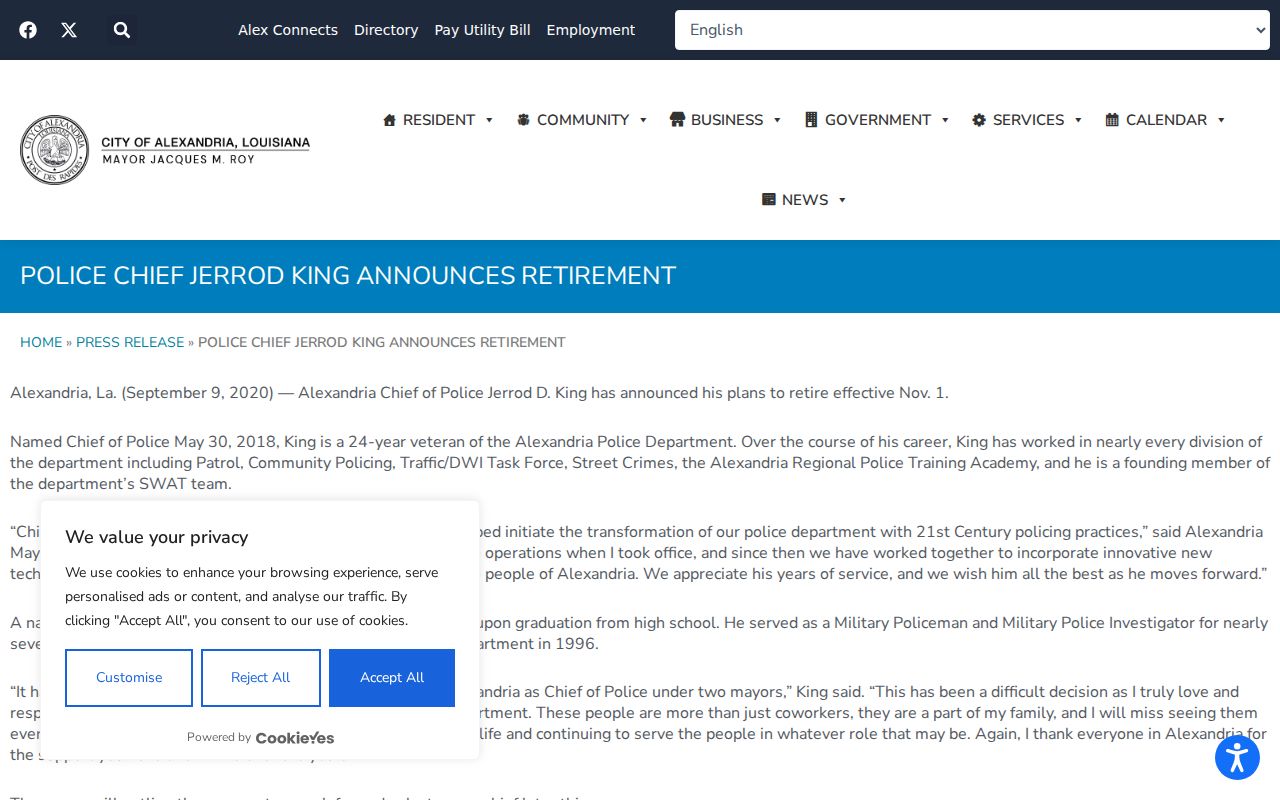
The image anchors the request process to APD, the custodian for its incident and arrest narratives.
Alexandria Police Department Records
Alexandria police records may include an initial incident report, offense report, arrest report, and material gathered in an investigation. These are not interchangeable with a rap sheet. An incident can exist without an arrest, and APD’s report can remain separate from later booking, prosecutor, and court entries. Ask for a named document rather than a vague background check.
An Alexandria request should supply requester contact information, an incident or report number if available, date, time, location, parties as lawfully identifiable, the exact pages or media sought, and the requested delivery method. These are practical identifiers, not invented mandatory web fields. APD warns that a request itself can become public. Active-investigation and other statutory limits may lead to redaction or temporary withholding.
When Alexandria Withholds an Active Police File
Louisiana law does not make every detective file immediately open. R.S. 44:3 permits limits for records tied to pending criminal litigation, active investigation, confidential sources, investigative techniques, or protected information. Yet an initial report, basic booking facts, and a full investigative file can receive different treatment. Ask APD to state the legal ground for withholding and to provide any reasonably separable public part.
An official Alexandria investigation notice illustrates how an active case directs tips to detectives rather than the routine records channel.
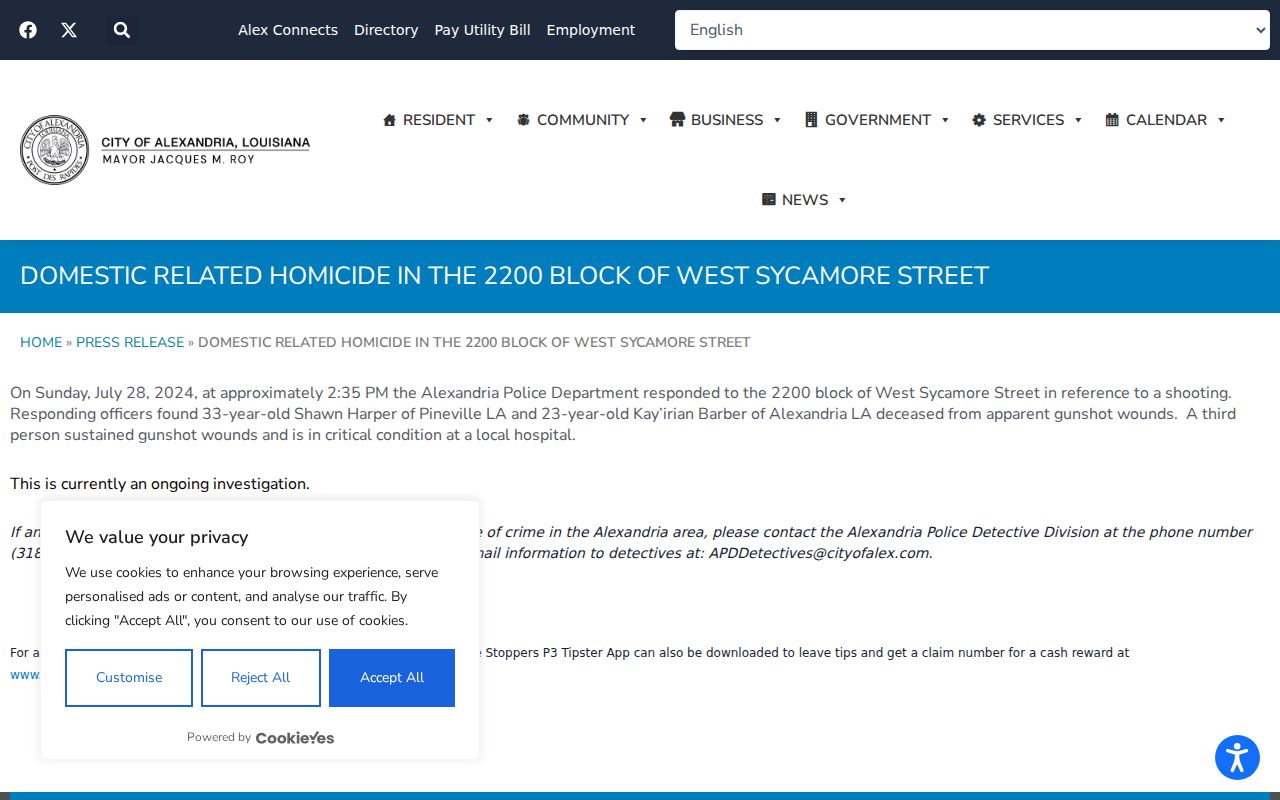
That distinction helps a requester contact Detectives for case information while leaving copy requests with Records.
Note: A withheld investigative file does not mean every basic fact about the Alexandria event is automatically confidential.
Alexandria Arrests and Bookings
After an APD arrest, the incident narrative remains with Alexandria Police, while custody information may appear in the Rapides Parish Sheriff’s Office roster. The roster is an alphabetic current-custody tool with an update time; it is not the official court judgment and warns against treating roster data as a complete public document. A released person may disappear even though APD and court records remain.
Use APD Records for the arrest or incident report, the parish roster for current custody, and the relevant clerk for the filed charge and outcome. For a deeper explanation of booking data, use the Rapides Parish Arrest Lookup. These sources can disagree for ordinary timing reasons: police label an alleged charge at arrest, prosecutors choose what to file, and a court later records the disposition.
Alexandria record path: APD report › parish booking › city or Ninth JDC filing › final disposition.
Alexandria City Court Wards and Docket Days
Alexandria City Court serves Wards 1, 2, and 8 from 515 Washington Street. It is open Monday through Friday from 8:00 a.m. to 4:00 p.m. Tuesday is the criminal docket day, Thursday is traffic day, and Monday is used for special settings. The renovated secure building contains two courtrooms and separate clerk, marshal, bond and fine, Pretrial Intervention, and prosecution functions.
The phone lines reflect those divisions: Clerk 318-449-5146, Marshal 318-449-5149, Judge 318-449-5151, Probation and PTI 318-449-5101, prosecutors 318-449-5176, and bonds or fines 318-449-5135. A reader seeking an Alexandria case copy should call the Clerk, while a payment or bond question belongs on its own line. The citation-payment portal is a payment tool, not a public name-based case search.
Municipal Court Records in Alexandria
Alexandria City Court hears traffic, city-ordinance, and criminal matters within its statutory jurisdiction. City material describes a penalty ceiling of $1,000 and/or six months. State-law felonies proceed in Ninth Judicial District Court, not through the city payment page. No verified public name or case search was found for Alexandria City Court, so the clerk counter and phone are the access route.
| Court Name | Alexandria City Court, 515 Washington Street |
|---|---|
| Case Types Heard | Traffic, municipal ordinance, and criminal matters within city-court jurisdiction |
| Case Lookup Channel | Clerk by phone or in person; no verified public name search |
| What the Docket Shows | Charge, settings, plea or disposition, sentence, fines, and case activity when public |
| Copies & Fees | Ask the clerk for the current copy and certification charge |
A certified court disposition carries more weight than a payment receipt when the precise Alexandria outcome matters.
Alexandria Court Functions Under One Roof
The Washington Street facility’s two courtrooms and separate counters explain why one general phone call may not settle every Alexandria question. The Clerk controls filed records. The Marshal handles court process. Bonds and fines have a dedicated function, as do prosecution and PTI. Route the request by record type and use a case number when available.
The City of Alexandria’s official site provides the municipal context for local offices and notices.

The city source complements the court and police channels without replacing either custodian’s official file.
Where Alexandria Records Go
An APD report begins at the city level. If police book a person into parish custody, the booking record belongs to the sheriff. A lower-level city matter can remain in Alexandria City Court, while a felony-level state prosecution goes to the Rapides Parish Clerk and Ninth JDC. Reported fingerprints and dispositions may then become part of Louisiana State Police’s LACCH repository.
Record flow: Alexandria PD › Rapides Parish Courts › Louisiana State Police Bureau of Criminal Identification and Information.
LACCH is not a public people-search database. A person seeking their own Louisiana history uses the fingerprint-based Right to Review. It can show identifiers, arrest cycles, charges, reported dispositions, incarceration, and probation or parole entries, but it excludes other states. For one Alexandria prosecution, the certified court disposition remains the strongest outcome source.
Reading Alexandria Police Crime Data
Alexandria published Certified APD Crime Data 2025 in January 2026. It is the preferred current official city statistical source, but the research did not invent counts from its image-based PDF. Population figures also need a date: the Census Bureau estimated Alexandria at 43,133 on July 1, 2024, compared with 45,275 in the 2020 Census.
Do not combine a 2025 APD count, a 2024 population estimate, and Ball’s 2020 count into a purported same-year comparison. Statistics describe reported events, not the content of a named person’s Alexandria criminal history. A specific record still must be checked at APD, the court, or the relevant repository.
Alexandria From River Town to Parish Seat
Official Alexandria history traces the site to Alexander Fulton’s 1785 Spanish land grant and the town layout to 1805. Its Red River position supported transport, trade, and agriculture. The city later became the parish seat and now contains parish court offices as well as the Alexandria Division of the federal court.
This layered civic role matters to record searches. Alexandria City Court does not hold Ninth JDC felony files, and neither local court holds a Western District federal docket. Federal cases use PACER. A request tied to an Alexandria address must therefore identify which government brought the case before choosing a clerk.
An official Louisiana State Police Alexandria investigation update shows another possible custodian.
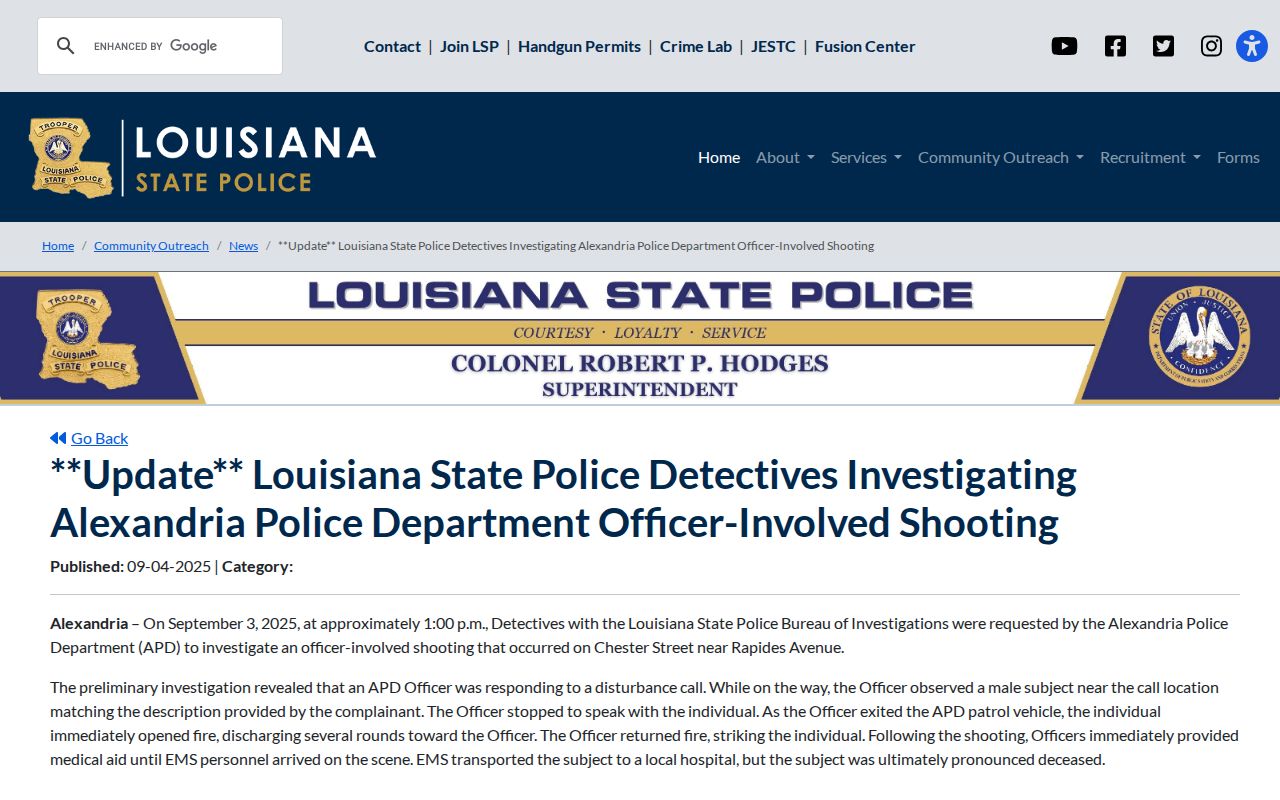
When LSP leads an Alexandria investigation, the originating record may sit with state police rather than APD.
Public Access Rules in Alexandria
Louisiana’s public-record framework applies to Alexandria agencies, but the custodian and record type still control. Court files belong to the judicial custodian. APD holds its law-enforcement records. LACCH dissemination follows separate criminal-history statutes. A city public-record request cannot compel APD to provide the restricted state repository product.
Key Statutes:
Louisiana Public Records Law, R.S. 44:1 defines public records and custodians.
R.S. 44:3 provides law-enforcement and investigative-record exceptions.
R.S. 15:587 controls permitted criminal-history dissemination and related fees.
R.S. 15:588 authorizes a person’s fingerprint-based Right to Review.
Ask for segregable public portions when part of an Alexandria file is exempt. Record a case or report number, the office contacted, and the date of the request so follow-up stays tied to the correct custodian.
Building a Verifiable Alexandria Record Trail
An Alexandria criminal record is easiest to verify when each stage is documented separately. Save the APD request and response, note the report number, record the parish booking identifier if one exists, and obtain the court case number. If the court result has not reached a state history, request a certified disposition before asking Louisiana State Police to review a possible LACCH mismatch.
Names alone are weak identifiers, especially when aliases or suffixes are involved. Date of birth can help a custodian narrow a lawful search, while a case number or report number is better still. Do not combine two people simply because a roster or docket returns a similar name. Alexandria police, court, and repository records each have their own identity controls.
The final chronology should distinguish allegation, custody, filing, and outcome. An APD report records what police documented. Booking shows custody. A bill or docket shows what was filed. The disposition shows how the court resolved it. Keeping these stages separate prevents an old Alexandria arrest label from being repeated after a charge changed or ended.