
Rapides Parish Criminal Court Cases
The Ninth Judicial District Court is Rapides Parish's general-jurisdiction trial court. Its seven elected divisions share three criminal sections, and the District Court receives felony and misdemeanor prosecutions filed by the Rapides Parish District Attorney. The Clerk's Criminal Department opens the numbered file, accepts pleadings, records minutes, and issues court process. Alexandria and Pineville city courts maintain their own lower-court dockets; Ball Mayor's Court keeps municipal matters. A city arrest does not by itself show which court ultimately received the case.
Start with the court named on the citation, bond paper, subpoena, or charging document. If the prosecution is captioned State of Louisiana v. Defendant in Ninth JDC, the Rapides Parish Clerk is the custodian. For Alexandria City Court or Pineville City Court matters, contact that court's clerk because those records are not automatically duplicated in the district-court file.
Inside the Rapides Clerk Criminal Department
The Clerk's public counter is in Suite 102 of the Rapides Parish Courthouse, 701 Murray Street, Alexandria, Louisiana 71301; the main number is 318-473-8153. The Criminal Department manages felony, juvenile, misdemeanor, and traffic filings, preserves minutes for each docket, and issues bench warrants, subpoenas, bond-forfeiture notices, and victim notices. Criminal filings are not accepted by fax. The first-floor counter is distinct from courtrooms on the sixth floor, where Ninth JDC Motion Hour is normally held Tuesday through Friday in Courtroom 1 or 2.
Ask the desk for an identifiable file by docket number, defendant name, filing year, or charging instrument. Court normally opens at 9:30 a.m. on weekdays other than legal holidays, but counter availability and hearing schedules should be confirmed before travel. The Clerk warns that official court-appearance notices are not sent by email, an important check when a message unexpectedly demands money or personal information.
Searching Rapides Parish Case Records
Rapid E-Search provides subscription inquiry and document purchasing for indexed Rapides records. Criminal indexing generally begins in 1984, and Bills of Information are available online from May 2003 forward. The service is not a free statewide search; Louisiana has no single free, comprehensive trial-court database. Use the local portal for Ninth JDC, the appropriate city court for municipal cases, and the Clerk's physical archive for older or absent records.
- Open Rapid E-Search, register or sign in, and choose the criminal search area rather than assuming a civil index covers the case.
- Search by docket number when known; otherwise use the defendant's name and narrow with the filing year or case category.
- Compare identifiers and the caption before opening a result, especially where people share a name.
- Read each count, minute entry, hearing, pleading, disposition, and sentence rather than relying on a status label alone.
- Request a copy or certified disposition from the Clerk when the document will be used to establish the official outcome.
| Search field | Format | Best use | Limit |
|---|---|---|---|
| Defendant name | Text | Finding an unknown docket number | Confirm similar names with other identifiers |
| Docket number | Number/text | Opening a known Ninth JDC file | Must match the originating court |
| Filing year | Year | Narrowing a common-name result | Not the same as arrest year |
| Case category | Selection | Separating criminal from other filings | Portal labels do not replace document review |
| Document image | Purchase/view | Reading a filed pleading or minute | Availability varies by date and document |
Rapid E-Search Coverage and Access
The Clerk publishes daily, monthly, and annual access choices for Rapid E-Search and states that the system's daily backup begins at 3 a.m. Online inquiry is useful for locating an indexed file and purchasing available images, but the service terms say the physical records filed and indexed in the Clerk's office are the official public records. A portal printout is therefore useful for research; a Clerk-certified copy is the stronger choice when the authenticity or final disposition matters.
The official Rapid E-Search access page is shown below. Its account-based entry point explains why a reader may encounter registration or payment before viewing documents.
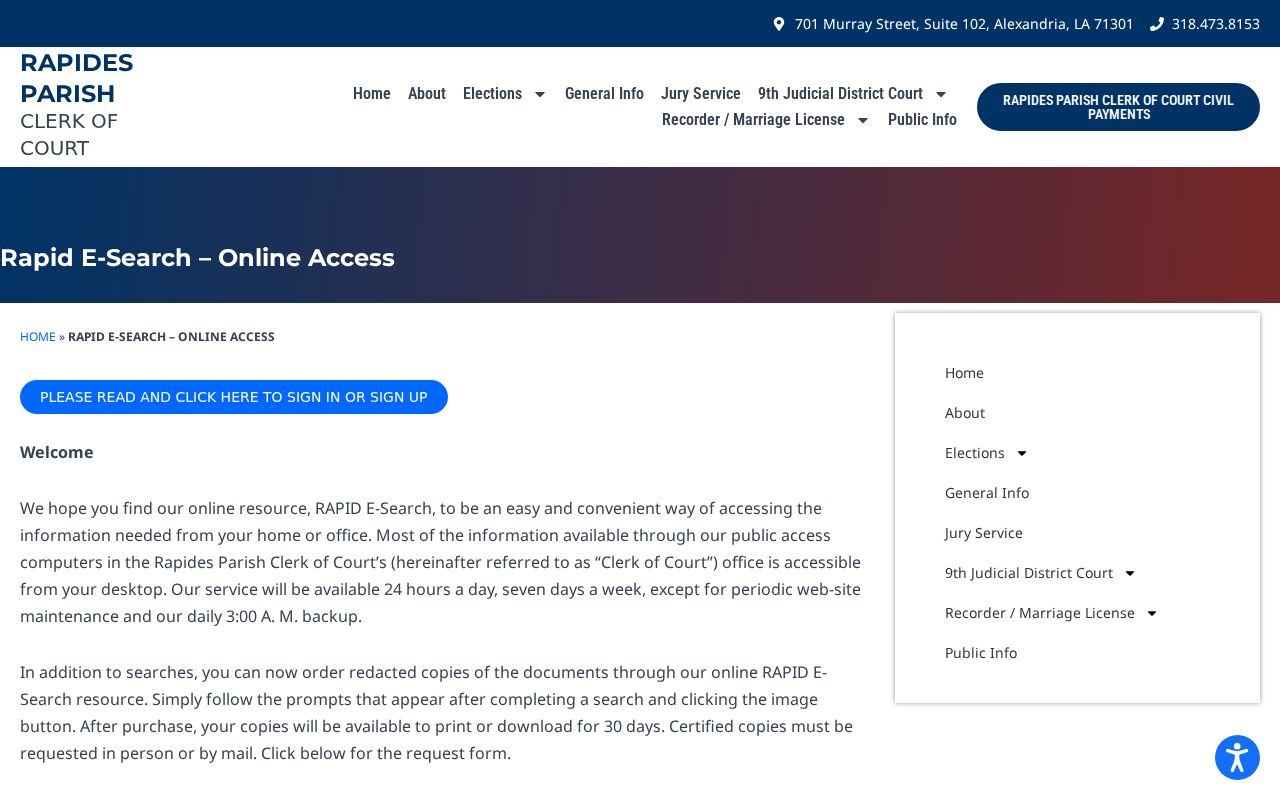
The captured access screen supports the practical distinction between an online inquiry and a counter request for the controlling courthouse record.
Inside a Rapides Parish Case File
A criminal file should be read count by count. It can identify the arrest or summons that brought the defendant before the court, the Bill of Information or other charging document, amendments, pleas, motions, hearing minutes, process, bond activity, disposition, sentence, and later orders. A generic “closed” status does not establish a conviction: the file may close after dismissal, acquittal, diversion, plea, sentencing, transfer, or another procedural event.
| Case Number & Court | Identifies the docket and whether Ninth JDC or a lower court owns the file. |
|---|---|
| Charging Document | Lists the prosecution's filed counts, which can differ from booking allegations. |
| Docket Entries | Chronological filings, minutes, motions, warrants, subpoenas, and bond events. |
| Hearing Dates | Arraignment, motion, trial, sentencing, and other scheduled appearances. |
| Disposition & Judgment | The result for each count, including dismissal, acquittal, plea, or conviction. |
| Sentence & Conditions | Custody, supervision, fines, costs, credit, and court-imposed conditions when entered. |
What To Do With a Pre-1984 Case
Rapid E-Search's criminal coverage begins in 1984, so no online result for an older event is not a finding that no case existed. Rapides records also have a deeper historical boundary: many pre-1865 records were lost in a Civil War-era courthouse fire. For a twentieth-century file outside the online index, give the Clerk a defendant name, approximate filing or arrest date, charge if known, and any docket reference, then ask staff to check the physical index or archive.
Do not force an old matter into a current portal date field or rely on an aggregator. The courthouse record controls. If a certified outcome is needed, ask whether the underlying minute, judgment, or disposition survives and what copy or certification options are currently available.
Alexandria City Court or Ninth JDC?
Alexandria City Court serves Wards 1, 2, and 8 and keeps its own misdemeanor, traffic, and city-ordinance docket. Its clerk can be reached at 318-449-5146, while the Marshal's office is 318-449-5149. The court's payment portal handles citations; it is not a public name-based criminal-case search. When a municipal matter does not appear online, call or visit the city clerk with the name, citation number, and approximate date. Alexandria City Court's stated criminal jurisdiction does not convert a felony prosecution into a city file.
Ninth JDC remains the place for state-law felony prosecutions and the district matters filed by the Rapides Parish District Attorney. Pineville City Court likewise maintains a separate docket at 904 Main Street and can be reached at 318-449-5656; its online nCourt page is also a payment channel rather than a general case lookup. Ball Mayor's Court at 100 Municipal Lane handles municipal matters and is not one of the Ninth JDC divisions. The best routing clue is always the court name on the filed process, not merely the police department that made the arrest.
How a Criminal Case Moves
The arresting agency first records alleged conduct, but the District Attorney decides whether and what to file. The Clerk's court file begins when papers arrive. Arraignment records the plea; pretrial entries can include discovery, motions, continuances, subpoenas, bond changes, and warrants. A plea or trial resolves the filed counts, after which the court records a disposition and, when appropriate, a sentence. The result should later flow to LSP's LACCH repository, although reporting lag can leave the state history incomplete.
Case flow: Charges Filed › Arraignment › Pretrial › Plea or Trial › Disposition › Sentencing
Western District Cases Use Federal Channels
Federal prosecutions arising in Rapides Parish belong to the U.S. District Court for the Western District of Louisiana, not the Ninth JDC file system. The official court site provides courthouse and procedural information.
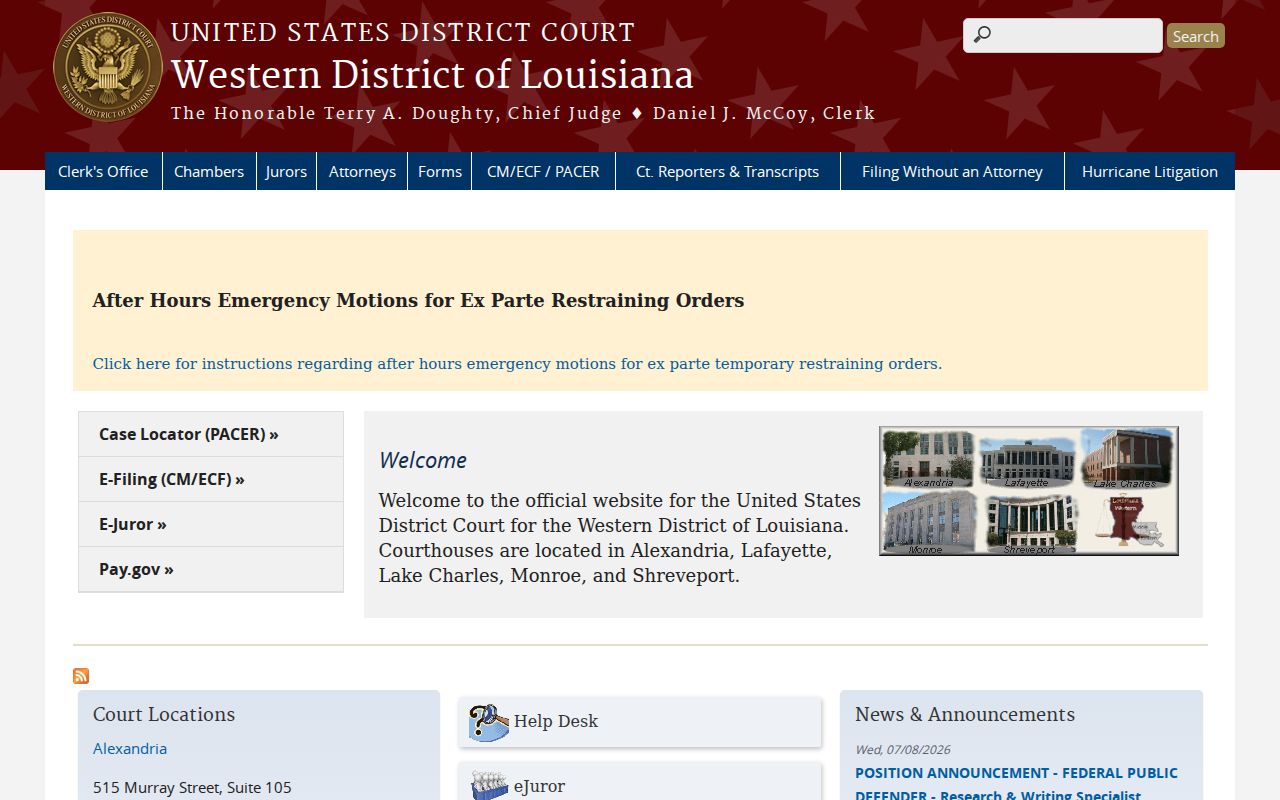
The federal court image marks the jurisdictional split: a Rapid E-Search failure is expected when the case was filed federally.
Federal dockets and filed documents are searched through PACER, whose judiciary fee schedule and account rules apply.
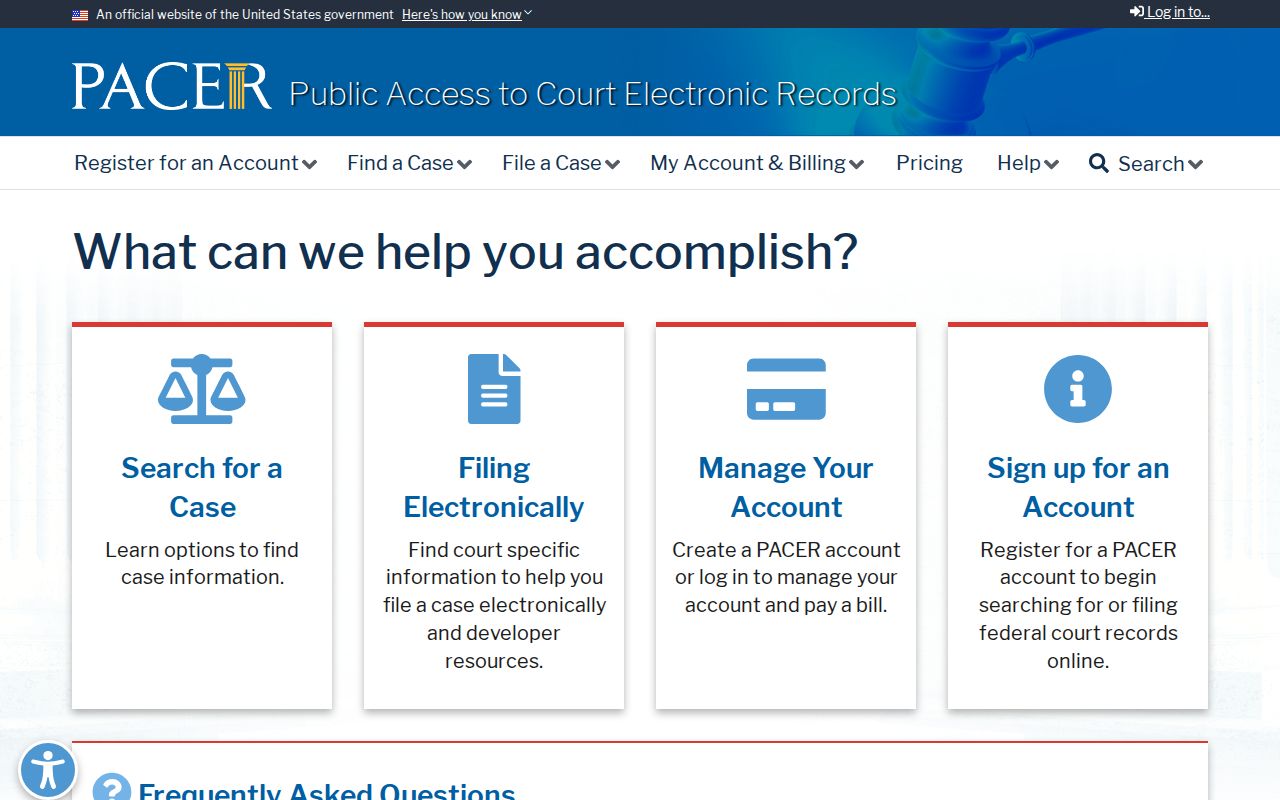
PACER complements rather than duplicates the Rapides Clerk system; search the court that actually received the prosecution.
Case Record Access & Restrictions
Louisiana court files are generally available through the clerk, but access is not absolute. Juvenile material, sealed or expunged records, victim-sensitive data, protected identifiers, and portions tied to active investigations may be withheld, restricted, or redacted. Louisiana Public Records Law, including R.S. 44:1 and the law-enforcement exceptions in R.S. 44:3, does not turn every investigative document into an open court exhibit.
If a case does not appear remotely, contact the originating clerk and describe the specific existing record. Ask whether the issue is date coverage, a different court, delayed indexing, sealing, or a name variation. The Criminal Department can explain filing and copy mechanics but cannot choose a legal theory or give legal advice. For an expungement filing, use the current statewide forms and Clerk checklist, identify every agency to be served, and confirm the current assessment rather than relying on an old fee figure.